

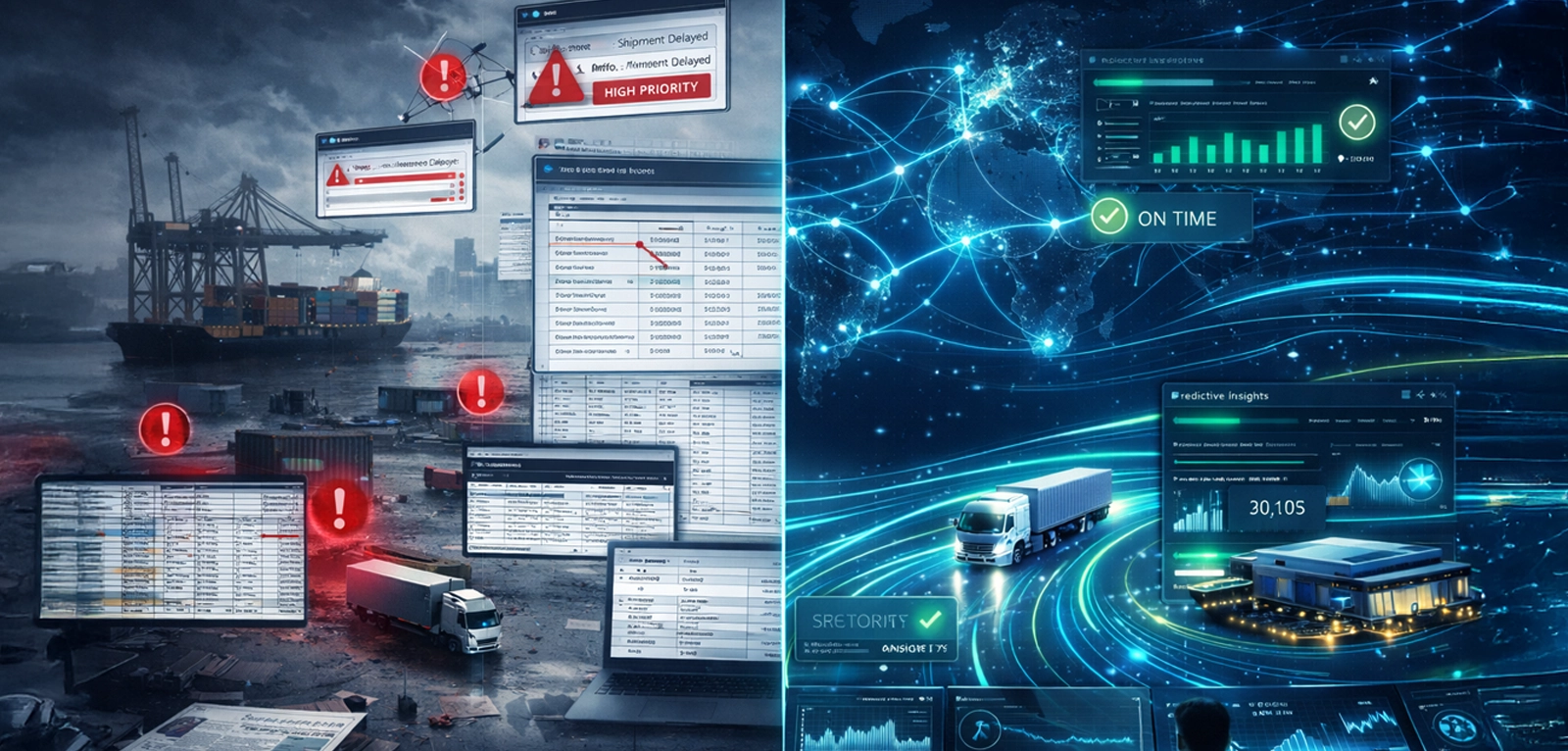
Modern supply chains are highly complex. There are multiple moving parts involved — from procurement and inventory management to last-mile delivery. Companies also have to coordinate with various stakeholders to complete tasks and deliver orders on time. This complexity makes supply chain management increasingly challenging.
Adding to the challenge, companies also struggle with data silos and fragmentation. While companies diligently collect data, most of it gets scattered across systems such as the Transportation Management System (TMS) and the Warehouse Management System (WMS). As a result, stakeholders lack access to a single source of truth. They are left relying on isolated data versions and conflicting interpretations.
This data fragmentation limits the supply chain’s capabilities. With no real-time insights or single source of truth, decision-makers are left firefighting rather than proactively managing situations. Poor decision-making, delivery delays, fulfillment issues, and diminished customer experiences have become common. In a fast-paced world, companies cannot operate effectively with fragmented data. They need a resilient, fully visible, and connected supply chain. That’s why supply chain orchestration has become so essential.
What is Supply Chain Orchestration, and why do companies need it?
Supply chain orchestration is the process of synchronizing data in real time across systems such as TMS and WMS. By unifying data, decision-makers gain a “control tower” view of orders, shipments, and warehouse operations across the supply chain.
Supply chain orchestration offers an array of benefits, including:
Better supply chain visibility: With all data available in a single location, decision-makers have real-time visibility across the supply chain. They can predict demand, identify anomalies, and respond faster to market needs. For example, they can optimize routes or reroute vehicles if unexpected disruptions such as traffic congestion occur on the usual route.
Streamlined operations: Supply chain orchestration enables decision-makers to identify potential issues such as equipment breakdowns, dock congestion, or other disruptions and make proactive adjustments to prevent them.
Better compliance: Every region has its own supply chain regulations. Tracking each requirement manually is cumbersome. By keeping all data in one place, companies can build a comprehensive audit trail, track certifications, and respond quickly to regulatory hurdles. This is particularly beneficial for international trade, where compliance is critical.
Resilience in the supply chain network: Modern supply chains are no strangers to geopolitical conflicts, economic tensions, weather fluctuations, and other bottlenecks. Supply chain orchestration provides real-time data on such problems and enables decision-makers to pivot quickly and minimize disruptions.
Faster decision-making: Without real-time data visibility, decision-makers will have to rely on historical data and guesswork. Supply chain orchestration provides a comprehensive view of all the data. It enables decision-makers to predict demand and potential disruptions, and to make quick decisions to meet market expectations.
On-time deliveries: From dock scheduling to route optimization, supply chain orchestration automates all these processes, making it easy for companies to ship and deliver orders to customers on time.
How Can AI Help with Supply Chain Orchestration?
AI-powered platforms, such as CSCS’s SCOTI, provide real-time API, EDI, JSON, and flat-file integrations to orchestrate supply chain data. It acts as an intelligent orchestration layer above existing systems such as TMS, WMS, ERP, and IoT, ingesting and harmonizing data from multiple sources to provide a holistic view of the supply chain.
It improves real-time interoperability between systems, contextualizes data, and enables decision-makers to make better decisions. The AI-powered integration helps companies with:
Real-time supply chain tracking: Supply chains are closely interconnected. A single issue at any stage can disrupt the entire system and cause chaos. To operate smoothly, supply chains need real-time insights, and that’s where AI comes in. It continuously gathers and unifies data streams from all connected systems using APIs and connectors. It provides clear end-to-end visibility across the entire supply chain and helps decision-makers understand the network’s interdependencies and make informed choices. From warehouse operations to transportation updates, AI’s real-time tracking enhances efficiency and resilience throughout the network.
Anomaly detection: The AI agents are trained on diverse datasets, enabling them to efficiently analyze patterns and flag deviations immediately. For example, AI models can detect issues such as temperature excursions, potential equipment failures, and other subtle anomalies that humans often miss. This enables decision-makers to act immediately and prevent the problem from escalating further.
Exception management: Companies often face frequent exceptions, such as unexpected traffic snarls, dock congestion, and sudden demand spikes. With AI, companies can simulate various responses and outcomes to recommend or execute optimal solutions. For example, it can reroute shipments or reallocate inventory in situations like traffic snarls and unexpected demand.
Continuous improvement: Unlike traditional AI models that learn from historical data or wait for human training, agentic AI continuously learns from every event and outcome. It validates its recommendations against predefined performance benchmarks and continuously refines and optimizes the model. This continuous self-learning and self-validation refine models, decisions, and outcomes.
Why Does Human–AI Collaboration Matter?
There is a widespread misconception among the workforce that AI will replace them. While AI handles much of the operational workload, such as automating tasks and analyzing data to recommend solutions, human intervention still plays a significant role. AI augments human capabilities rather than replacing them. It will take over manual or low-value tasks, freeing humans to focus on high-value work such as strategy development and improving business outcomes.
Critical decision-making authority remains with humans, given their cognitive abilities. More importantly, humans are responsible for setting up governance and guardrails. This will help improve data accuracy, uphold AI ethics, and align AI models with business goals and stakeholder expectations.
How to Move from a Fragmented to a Fluid Supply Chain?
CSCS’s agentic AI platform, SCOTI, helps companies transform their supply chain from fragmented to fluid. It integrates existing ERP, WMS, OMS, and TMS environments and improves supply chain orchestration. This helps companies automate workflows across all systems, detect deviations or exceptions and trigger automated resolutions. Most importantly, SCOTI continuously learns from data, adapts decisions based on context, and executes tasks independently.
SCOTI has helped companies achieve forecast accuracy of 99.2%, reduce manual tasks by 80%, and process 100+ demand variables simultaneously in real time. However, companies should recognize that the transition from a fragmented to a fluid supply chain does not happen overnight. It occurs in a phased manner.
A recommended phased approach includes:
Understanding the pain points, picking a dedicated pilot project for implementation, and monitoring the changes in performance.
If successful, expand AI workflows, monitor KPIs, and improve workflows for better outcomes.
Establish governance frameworks and scale them to other processes and operations.
A phased approach, combined with a powerful AI-powered platform like SCOTI, can help companies build a resilient supply chain that operates efficiently across both predictable and unpredictable scenarios.
Ready to implement an AI-powered solution to transform your supply chain? Contact us for more information.
Frequently Asked Questions (FAQ)
Q. What is supply chain orchestration?
Supply chain orchestration is the process of integrating TMS, WMS, and other systems to synchronize real-time data and provide a unified view of the entire supply chain.
Q. How can AI aid supply chain orchestration?
AI acts as an orchestration layer above existing systems, such as TMS, WMS, and IoT systems, ingests real-time data from these systems, and provides a holistic view of the entire supply chain.
Q. Why is Human-AI collaboration important?
While AI helps with basic automation and decision-making, human intervention is required to maintain AI ethics, set governance and guardrails, and align AI models with business goals.