

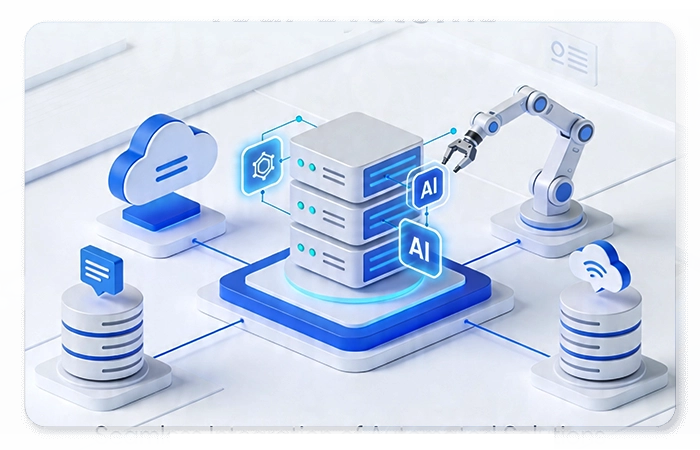

CSCS enables legacy ERP, WMS, and TMS systems to support automation through a real-time orchestration layer, avoiding costly system replacements. This approach speeds deployment, lowers risk, and supports gradual adoption. By bridging existing infrastructure with modern automation, CSCS preserves institutional knowledge while unlocking advanced capabilities delivering faster value, reduced total cost of ownership, and a transformation path aligned with business priorities.
Supply chain, warehouse, and logistics operations face intense pressure to adopt automation due to labor shortages, customer expectations for speed and accuracy, and competitive demands. While organizations are investing in robotics, AMRs, AGVs, AS/RS, and intelligent conveyors, many automation efforts are hindered not by the technology itself but by legacy ERP, WMS, and TMS systems.
These older platforms are built for batch processing and periodic updates, lacking the real-time integration and event-driven communication modern automation requires causing projects to stall, exceed budgets, or fail to deliver expected ROI.
Persistent labor shortages across logistics and fulfillment operations.
Growing demand for same-day and next-day delivery.
Rising operational complexity from omnichannel fulfillment.
Competitive pressure to reduce costs while improving service levels.
Most enterprise systems were built for an earlier era of batch-based processing and periodic updates, relying on manual coordination. They weren't designed to communicate in real time with modern automation technologies that need continuous feedback and dynamic execution adjustments
.
Data and logic are scattered across multiple systems with inconsistent formats, making unified orchestration nearly impossible without extensive custom development.
Business rules are embedded deep within application code, requiring expensive modifications and extensive testing to introduce new automation workflows.
Systems rely on scheduled batch jobs and periodic synchronization, creating delays that prevent real-time coordination with automation equipment.
Older platforms lack modern, event-driven APIs, forcing teams to build brittle point-to-point integrations that are difficult to maintain and scale.
The result is a significant gap between what automation technologies can do and what legacy systems can support. Bridging this gap typically requires either replacing core systems or settling for underperforming automation that never realizes its full potential.
Automation Enablement is CSCS's strategic approach to preparing existing enterprise systems for automation without costly replacements or replatforming. It leverages SCOTI™ as an intelligent orchestration layer between legacy systems and modern automation technologies.
CSCS focuses on creating the real-time integration and orchestration logic that enables current systems to communicate with automation equipment and coordinate execution without extensive customization.
Keep your existing systems and leverage their proven business logic and historical data to drive modern results.
Deploy automation capabilities progressively, reducing implementation risk and allowing for continuous operational optimization.
Enable seamless communication and coordination between legacy platforms and the latest automation technologies.
Build a flexible foundation that adapts as automation technologies and business requirements evolve over time.
SCOTI™ serves as the real-time integration and execution layer that connects your legacy enterprise systems with modern automation technologies. Rather than forcing point-to-point integrations or requiring expensive modifications to your core platforms, SCOTI™ provides a unified orchestration fabric that translates, coordinates, and executes operations across your entire technology ecosystem.
SCOTI™ includes out-of-the-box integrations for major ERP, WMS, and TMS platforms, as well as leading automation equipment providers. This eliminates months of custom integration development and reduces implementation risk.
Unlike batch-based synchronization, SCOTI™ processes events in real time, enabling immediate responses to changing conditions on the warehouse floor or in transit operations.
SCOTI™ coordinates complex workflows across multiple systems and automation devices, ensuring tasks are sequenced properly, resources are allocated efficiently, and exceptions are handled intelligently.
Your core systems remain untouched. SCOTI™ abstracts automation complexity away from legacy platforms, preserving stability while enabling modern capabilities.
SCOTI™ acts as the intelligent middleware that transforms how your legacy systems interact with automation technologies. Instead of forcing your ERP, WMS, or TMS to directly manage real-time automation coordination, SCOTI™ handles the translation, orchestration, and execution management required for seamless automation operations.
This architecture enables event-driven orchestration where changes in one system immediately trigger coordinated responses across the entire ecosystem. For example, when an order is released in your WMS, SCOTI™ can instantly coordinate pick path optimization, allocate the appropriate AMR, update inventory availability, and adjust downstream conveyor routing all without requiring your WMS to understand the specifics of each automation device.
Your ERP, WMS, and TMS continue to serve as systems of record for orders, inventory, and business rules. SCOTI™ doesn't replace these functions it extends them with real-time execution capabilities.
SCOTI™ maintains continuous, bidirectional communication with all connected systems and devices, enabling immediate visibility and response to operational conditions.
Complex workflows that span multiple systems and automation technologies are orchestrated by SCOTI™, which ensures proper sequencing, resource allocation, and exception handling.
Automation Enablement through SCOTI™ delivers tangible operational and financial benefits that directly impact your bottom line. By eliminating the integration bottleneck and enabling your existing systems to support modern automation, organizations achieve faster deployments, lower risk, and superior return on investment compared to traditional rip-and-replace approaches.
Free human workers from repetitive tasks and enable them to focus on higher-value activities requiring judgment and problem-solving. Typical customers see significant improvement in effective labor utilization.
Eliminate manual handoffs and reduce dependency on human verification. Error rates typically drop dramatically across fulfillment and warehouse operations.
Process more orders with existing facility footprint through optimized automation coordination. Many operations achieve major throughput gains without facility expansion.
Deploy automation capabilities progressively, starting with highest-ROI use cases and expanding as you validate benefits and build organizational confidence.
For supply chain and logistics leaders with legacy systems, Automation Enablement offers a practical way to start automation without waiting for full system replacements. SCOTI™ adds real-time orchestration to existing ERP, WMS, and TMS platforms, reducing risk, speeding time-to-value, and allowing flexibility as technology and business needs evolve.
Organizations that succeed will be those that can coordinate and orchestrate across their technology ecosystem to drive operational performance not just those with the newest systems.
Discover how CSCS enables automation for operations running on legacy systems. Our team can assess your current environment and show you exactly how SCOTI™ can bridge your existing systems to modern automation technologies.


