

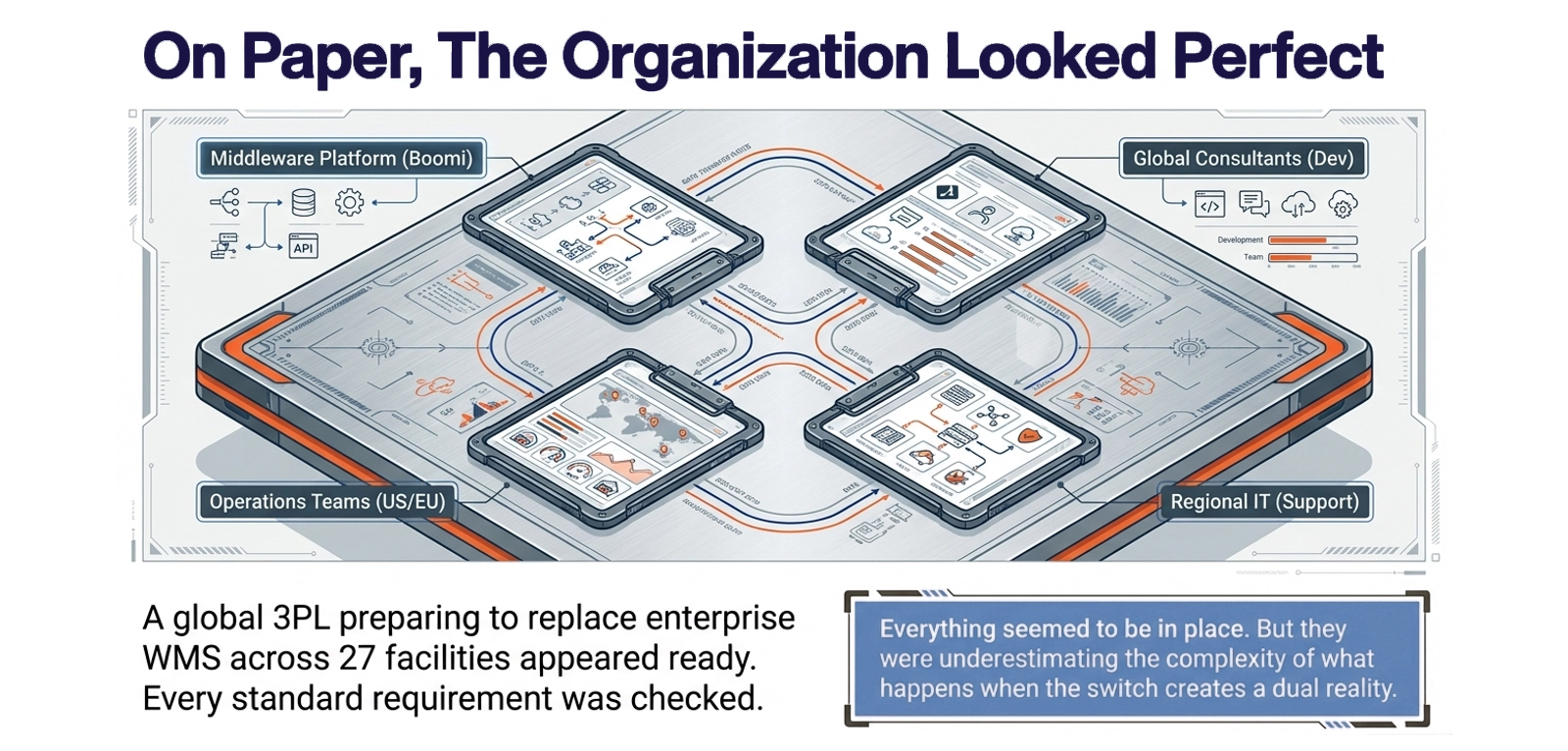
At Manifest, I had a compelling conversation with a Supply Chain VP from a global 3PL preparing for a large-scale WMS replacement across 27 distribution centers.
On paper, the organization appeared well-structured. They had:
An enterprise middleware platform (Boomi)
A large global consulting firm handling integration development
Business and design teams across the US and Europe
Regional IT teams supporting operations
Everything looked organized. But the real concern wasn’t software selection. It was this:
How do we move from a legacy WMS to a new platform, across 27 DCs, without breaking the business?
The Complexity Most Executives Underestimate
During a WMS migration, the business does not pause.
ERP continues sending orders.
Customers continue transmitting EDI files.
Shipments must be confirmed back correctly.
Billing must trigger accurately.
Inventory must remain synchronized.
And for months, both systems may run in parallel. The legacy WMS continues supporting active DCs. The new WMS begins onboarding selected sites. That means ERP, OMS, TMS, parcel systems, and billing platforms must integrate simultaneously with both environments. Now the challenge is no longer “integration development.” It becomes dual-system synchronization and orchestration.
Without the right architecture:
Orders can route incorrectly
Shipment confirmations can duplicate
Inventory positions can drift
ERP loses clarity on source of fulfillment
Billing accuracy suffers
Across 27 DCs, small gaps multiply fast.
Why Traditional Integration Models Fall Short
Many enterprises treat integration as:
A middleware license
A mapping exercise
An offshore development team
A technical side workstream
But multi-DC WMS replacement is not a connector problem. It is an enterprise event re-architecture problem. It requires:
Intelligent order routing logic
Event arbitration between legacy and new systems
Data normalization
Cutover sequencing governance
Parallel-run monitoring
Clear exception ownership
This is business continuity engineering – not plumbing.
A Different Approach: Enterprise Orchestration
At CSCS, integration is positioned differently. Not as middleware. Not as development capacity. But as enterprise supply chain orchestration. This means:
A secure, scalable iPaaS foundation
Deep supply chain domain architects
End-to-end integration design ownership
A global execution model (US, Europe, offshore)
Governance and real-time monitoring frameworks
Most importantly:
One accountable partner. One architecture. One orchestration layer.
When 27 DCs depend on synchronization, fragmentation is a risk. CSCS exists to eliminate that risk – by serving as the single partner responsible for architecture, execution, and continuity across the entire transformation. Because in a multi-DC migration, coordination is not enough. Accountability is everything.
The Executive Question
If you are replacing WMS across multiple distribution centers, ask yourself:
Who owns the integration architecture during coexistence?
If the answer is fragmented across vendors, regions, and development teams – you don’t have orchestration. You have coordination risk. The companies that treat integration as a transformation pillar -and partner with a single accountable orchestration provider – are the ones that execute migration without disruption.
And in a 3PL environment, continuity is everything.
About the Author
Maharajan Karthigaivelayutham is the Chief Delivery Officer at CSCS, with 30 years of integration experience helping enterprises modernize operations through intelligent integration, visibility, and automation.
Blog by:
Maharajan Karthigaivelayutham (Maha)
Chief Delivery Officer, CSCS