

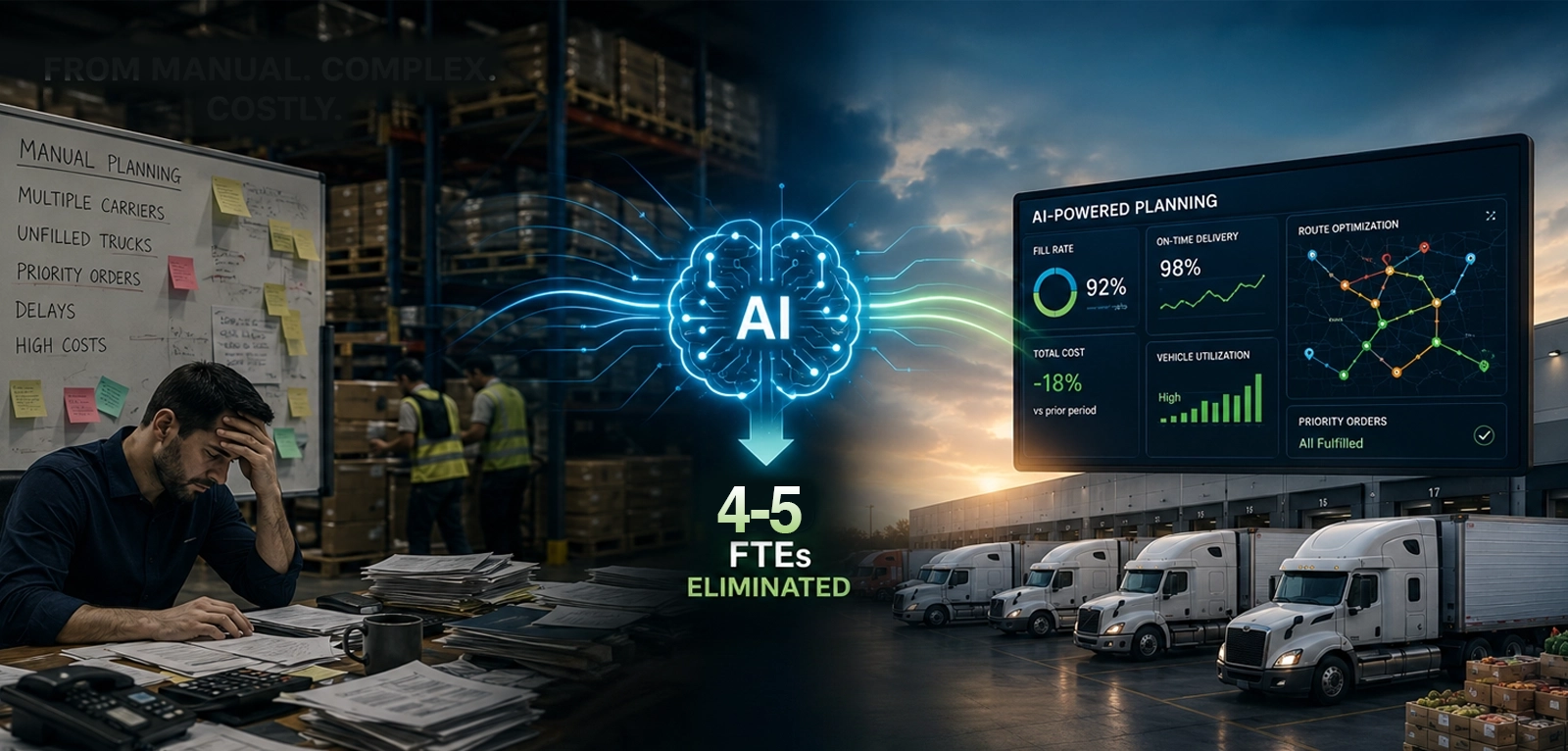
How a Leading Wholesale Grocer reduced workload by the equivalent of 4–5 FTEs per Distribution Center and Transformed Fleet Efficiency with AI-Driven Planning
Large Wholesale Distributor
Leading Wholesale Grocer
Size: Enterprise
Key Achievement: Workload Reduction Equivalent to 4–5 FTEs per Distribution Center + Fleet Optimization
Executive Summary:
A high-volume wholesale grocer was trapped in a cycle of manual planning, carrier chaos, and priority-order disruptions. By deploying the CSCS Consolidation Engine, an AI-powered TMS with advanced mathematical optimization, the organization reduced workload by the equivalent of 4–5 FTEs per distribution center, allowing employees to focus on higher-value strategic and operational initiatives while dramatically improving vehicle fill rates, and gained the flexibility to accommodate surge orders without operational disruption. The result: lower costs and better service, delivered simultaneously.
Importantly, these gains did not require workforce reductions. Instead, the organization repurposed employee capacity toward strategic planning, operational improvement initiatives, customer service enhancements, and growth-focused activities.
The Challenge:
For a wholesale grocer operating at scale, even minor inefficiencies in transportation planning compound quickly. This organization faced four interlocking problems that were quietly eroding margins and service quality:
Lack of Planning Flexibility Manual processes could not keep pace with the dynamic, high-volume nature of their order flow, especially during peak periods.
Scalability Constraints As order volumes grew, the existing system became a bottleneck: rigid, slow, and increasingly prone to shipping delays and wasted resources.
Priority Order Disruptions When urgent orders arrived, the team had no dynamic replanning capability. Accommodating them meant disrupting everything else in the queue.
Carrier Management Gap With no systematic approach to rate shopping, tendering, or competitive bidding, the company was leaving money on the table with every shipment.
Together, these inefficiencies were directly impacting profitability and threatening customer satisfaction an unsustainable position in an industry where margins are thin and reliability is non-negotiable.
The CSCS Solution
CSCS deployed its comprehensive Transportation Management System with the Consolidation Engine at its core a sophisticated AI-driven planning platform powered by advanced mathematical optimization models.
Legacy System Integration
CSCS integrated the Consolidation Engine directly with the client’s legacy mainframe, ensuring continuity of operations while modernizing the planning layer. No rip-and-replace. No disruption to daily operations.
AI-Driven Dynamic Planning
Machine learning algorithms and advanced mathematical models now generate flexible, adaptive shipment strategies in real time. The system responds to changing conditions automatically something manual planners simply cannot do at speed and scale.
Dynamic Load Planning
Operations teams can now absorb last-minute and high-priority orders without cascading disruptions. The system replans dynamically, optimizing across the entire order queue rather than treating urgent orders as exceptions to be handled manually.
Automated Carrier Tendering
Shipment execution shifted to an automated tendering and bidding process across a network of onboarded carriers. Manual, error-prone workflows were replaced with intelligent automation that consistently finds the best carrier at the best rate.
Measurable Business Impact
Metric | Result |
Operational Efficiency | Reduced workload by the equivalent of 4–5 FTEs Full-Time Equivalents (FTEs) per distribution center |
Fleet Optimization | Notable reduction in the number of transport units required |
Vehicle Utilization | Significantly improved fill rates through enhanced route optimization |
Order Flexibility | Seamless accommodation of priority and high-volume orders without disruption |