

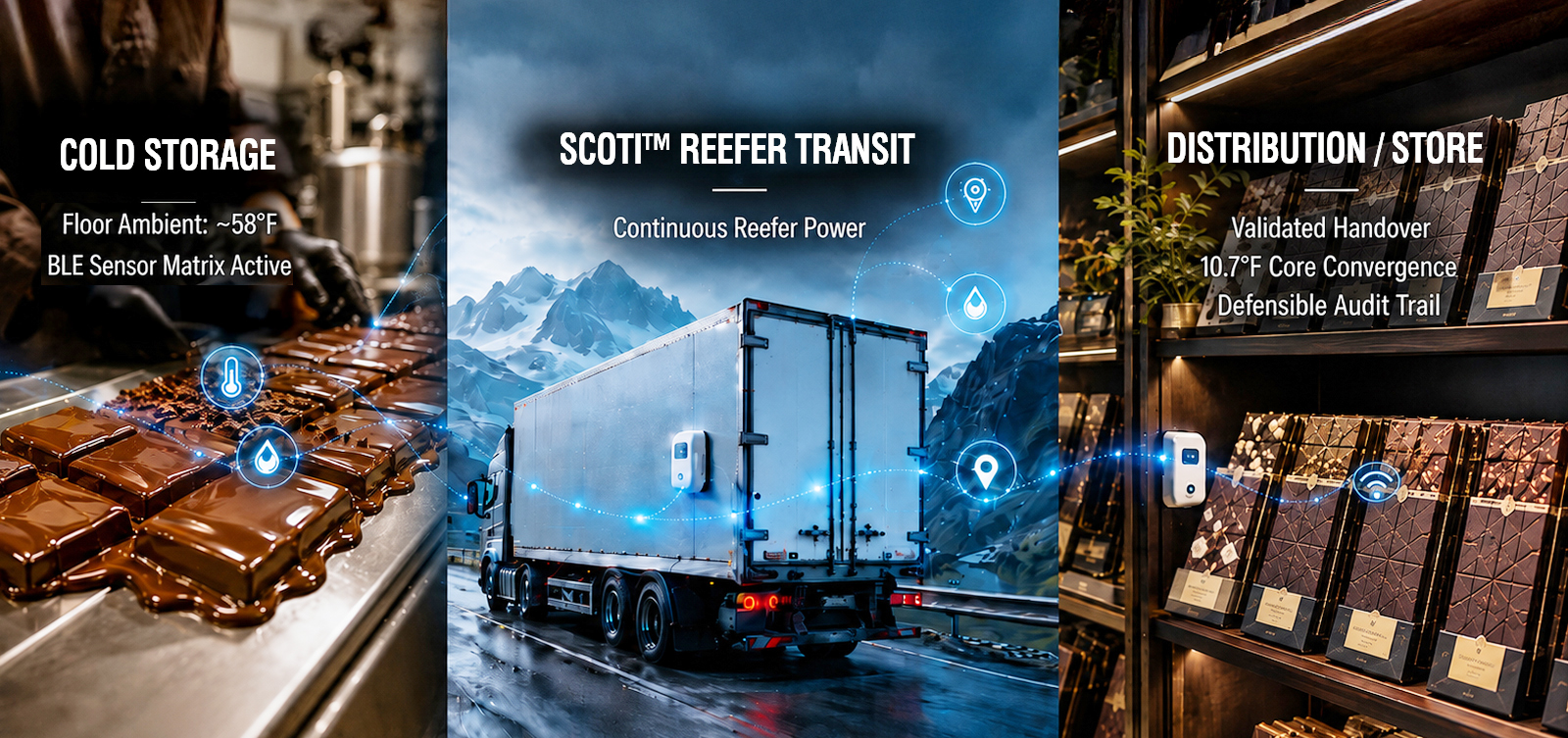
Project Delivery Spotlight – Storage to Shelf

Temperature, humidity, and location monitoring for a specialty food shipper moving craft chocolate through cold storage and reefer transit.

Project Delivery Spotlight | Specialty Chocolate Client - CSCS
From Storage To Shelf Temperature, humidity, and location monitoring for a specialty food shipper moving craft chocolate through cold storage and reefer transit.
Executive Summary

A specialty chocolate company managing temperature-sensitive products across cold storage, refrigerated transportation, and distribution. The company had no visibility into what actually happened to product once it left underground cold storage: how fast the pallet core reacted to ambient temperature swings, whether humidity was creeping into the product zone, and whether the reefer trailer itself was contributing to thermal stress.

CSCS deployed a multi-sensor monitoring kit onto a live outbound shipment and ran the same test twice, 21 days apart, changing exactly one variable between runs. That second test is what turned a single data pull into a defensible, validated finding.

"This is a very good summary. This will help us set up a standard for the future of this process."

Operations & Quality Leadership, Specialty Chocolate Client
What We Built

CSCS placed four BLE temperature and humidity sensors at defined cross-sectional positions on the pallet internal core, top, bottom, and side plus one GPS-enabled tracker, all reporting directly into the SCOTI™ platform at a 30-minute logging interval.

The multi-sensor kit ran through a full outbound operational cycle: underground cold storage staging, reefer trailer transit, and final warehouse delivery.

Core Capabilities
Multi-Point Micro-Climate Capture: Simultaneous temperature and humidity tracking across the entire pallet cross-section.
GPS & Dwell Time Analytics: Location-aware tracking confirming real-time transit movement and staging dwell duration.
Live Threshold Alerting: Automated telemetry broadcasting immediate alerts to customer teams during transit excursions.
Composite Thermal Model: Fuses four telemetry feeds into a single visual heat gradient representing true core product inertia.
Protecting Product Integrity From Thermal Degradation Without real-time IoT monitoring across the pallet core, unmanaged temperature spikes lead to fat bloom, structural melting, and loss of premium snap. SCOTI™ telemetry ensures pristine quality upon delivery.
Unmonitored Transit Thermal Excursion
Ambient Spike + Cycling Reefer ❌ Fat Bloom & Loss of Temper
Core temperature divergence reaches 21.2°F
Compressor cycling causes micro-thermal shocks
Unseen floor humidity risks product degradation
Result: Rejected Shipment & Financial Loss
SCOTI™ IoT Monitoring Continuous Control
Continuous Power & Core Mass Buffering ✓ Glossy Finish, Crisp Snap & Pure Flavor
Peak thermal spread halved to 10.7°F
Continuous power eliminates reefer noise
Floor humidity identified & isolated before transit
Result: 100% Validated Craft Quality Handover
Thermal Divergence: Test 1 vs Test 2 SCOTI™ Telemetry
Fig 1. Core-to-Exterior temperature spread over 72 hours. Test 2 (Continuous Power) eliminated compressor noise and halved peak divergence.
By The Numbers
5 Sensors / Test
30min Logging Interval
3days Test Duration
2 Controlled Runs
21.2°F → 10.7°F Drop in peak core-to-exterior divergence between Test 1 and Test 2
Delivery & Impact A controlled experimentation methodology designed to isolate reefer anomalies, validate thermal mass buffering, and establish cold chain standards.
How We Delivered It

CSCS structured the engagement around two controlled test cycles, separated by 21 days, changing exactly one variable to transform raw sensor telemetry into actionable operational intelligence.

Test 1 • June 15–18 Baseline Run (Reefer Cycling Power) Baseline run under the customer's existing reefer cycling power setting. Internal core temperature moved with every external transition but 6 to 10 times slower, confirming a real buffering effect from product mass. Mid-transit temperature noise was traced to reefer compressor cycling, not door events or handling. Peak spread between core and exterior hit 21.2°F, closing to 3.4°F by delivery.
Test 2 • July 6–9 Continuous Power Optimization Same sensor positions, same route, same product. One variable changed: reefer power set to continuous instead of cycling. The mid-transit noise from Test 1 disappeared entirely, confirming the original diagnosis. Peak divergence dropped to 10.7°F, and the internal sensor fully converged with exterior readings by the end of the run something Test 1 never achieved.

Running the same test twice with one controlled variable is what separated this from a one-off data pull. It gave the chocolate company a defensible before-and-after baseline instead of a single snapshot.

Core Consulting Practices CSCS partners with specialty shippers and food distributors to protect product integrity through specialized engineering practices:
Cold Chain Environmental Mapping
Multi-Sensor Telemetry & BLE Integration
Thermal Mass & Product Integrity Modeling
The Business Impact
A Confirmed Root Cause The thermal noise in Test 1's data had a specific, provable source: reefer compressor cycling. Test 2 proved it by removing the variable and watching the thermal noise disappear entirely.
A Repeatable Humidity Signal The bottom, front-of-line sensor ran elevated on both tests, before the truck leg even started. This was not one-time noise it was a moisture pattern tied to the cold storage floor, giving the company immediate operational visibility.
A Real Product Mass Model The internal core lag was proven not to be a sensor artifact. It held across two independent tests under two power settings, providing the chocolate company with a verified physical property of their product to plan around.
A Framework For What Comes Next The company now has a validated method for testing a third variable: capturing the full deep freeze leg, adding a second internal sensor at depth, and integrating reefer telemetry into SCOTI™.
Top Exterior Sensor Internal Core Sensor (Lag Zone) Side Sensor Bottom Moisture/Floor Signal
Fig 2. Multi-sensor micro-climate deployment across pallet cross-section.
About Us Validation Partner CSCS combines the SCOTI™ AI-native supply chain orchestration platform with practitioner-led delivery one accountable partner from first pilot to full-scale rollout. This engagement reflects our approach to cold chain and product integrity validation: instrument the real shipment, isolate one variable at a time, and hand the customer a finding they can act on, not just a chart.
MS
Mike Sharpe Chief Solutions Officer msharpe@cscs.io
RS
Rodney Sumlin Director of Customer Delivery rodney@cscs.io

Leave a comment


The reCAPTCHA verification period has expired. Please reload the page.