

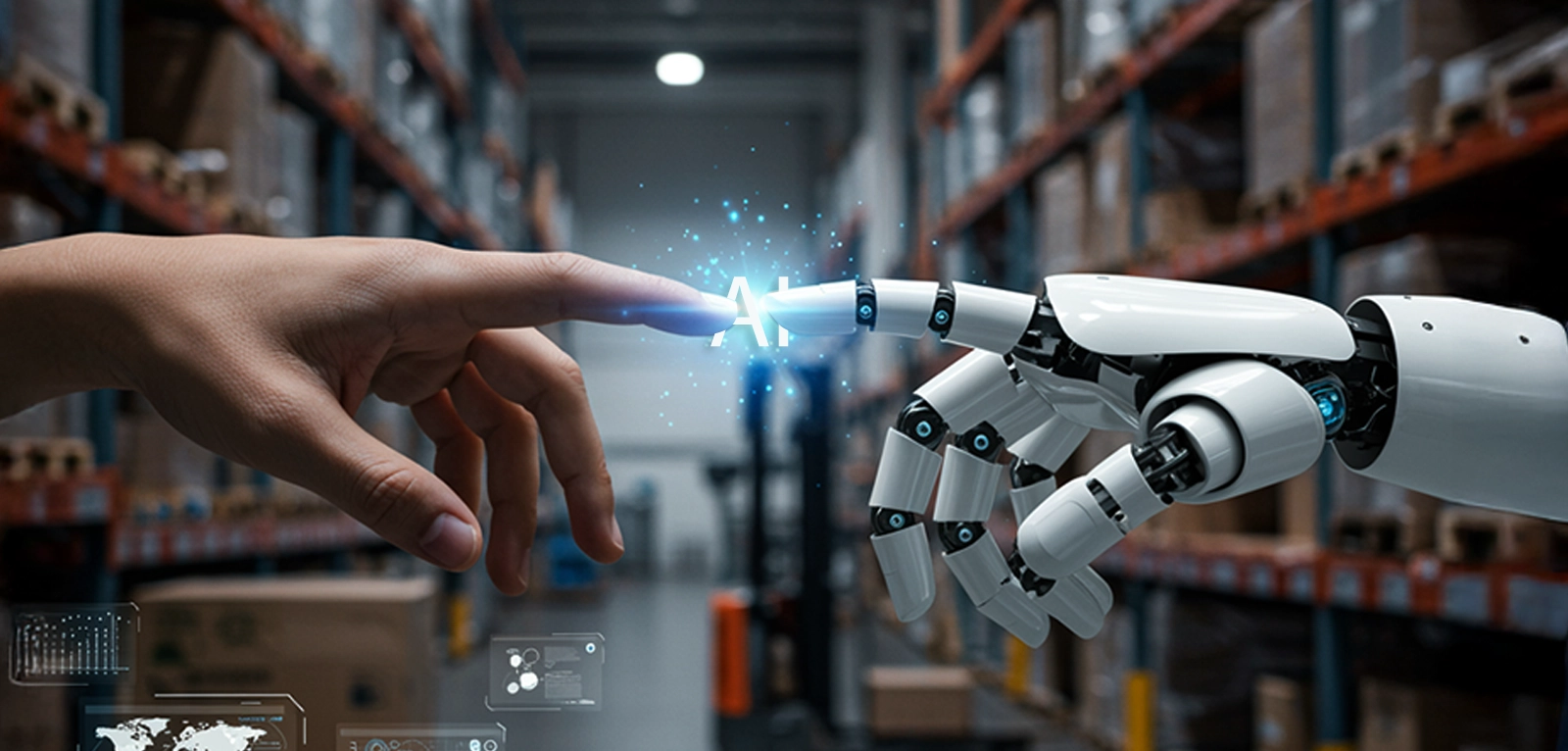
Today, AI dominates boardroom meetings, conferences, and water-cooler discussions across sectors. Closer to our playing field, companies are buzzing with anecdotes about how AI has improved the supply chain. But is this hype real?
While it’s true that AI is a game-changer for the supply chain, its limitations cannot be ignored.
AI provides real-time insights that help companies optimize processes and accelerate decision-making. However, it also comes with challenges, such as:
-
Lack of nuance in data: Although AI helps with data analysis, it lacks the nuance needed to interpret complex supply chain data effectively. It may generate insights that are overly simplistic or misleading and often fails to account for context-specific rules and exceptions.
-
Data bias: Bias in training data could lead to AI making unfair or inefficient business decisions.
-
Data inaccuracies: When an AI model is trained on outdated or fragmented data, it produces unreliable, misleading, or flawed outcomes.
Using biased, incomplete, or inaccurate data can derail supply chain operations, affect demand forecasts, and delay deliveries.
That’s why, while AI plays a significant role in automating the supply chain, companies cannot fully replace the human workforce. A strong human-AI partnership is crucial for empowering supply chains.
How Does Human-AI Partnership Improve Supply Chain Operations?
There has been widespread misconception – and even fear that AI will replace humans.
However, AI can complement humans, but never replace them. Supply chain operations are complex. While specific workflows can be automated, companies still require humans to coordinate with stakeholders and make critical decisions.
The responsibility lies with companies to clearly differentiate the roles of AI and humans.
To do that, companies must understand their strengths and leverage them.
AI excels at processing large datasets in real time, identifying patterns, and delivering actionable insights on factors such as weather fluctuations, traffic, and other roadblocks. However, it lacks the nuances and contextual understanding that humans possess. It has the data to automate processes or make basic decisions, but it cannot negotiate complex contracts, navigate regulations, or build relationships with suppliers. These tasks require complex human skills.
So, what can companies do?
Use AI as a co-pilot
In other words, make AI the assistant that manages resource-intensive, manual tasks, such as:
-
Integrating transportation management systems (TMS), warehouse management systems (WMS), enterprise resource planning (ERP) platforms, and IoT devices
-
Automating repetitive tasks such as route tracking and dock scheduling
-
Simulating “what-if” scenarios to optimize routes and assign docks
-
Processing large datasets to identify patterns, predict disruptions, and generate insights to help humans make informed decisions
The human role in this collaboration would involve:
-
Validating if the data generated is accurate and aligns with business needs
-
Using AI insights to make final and critical decisions that are contextually relevant
-
Overriding AI’s suggestions, when necessary, to avoid unfair or unethical business practices
-
Responding to market changes proactively with real-time insights generated by AI
-
Understanding complex compliance regulations and contracts that require human judgment and interpretation
-
Setting up guardrails and governance to maintain AI’s ethics and effectiveness
Let’s look at an example of how companies can use human-AI collaboration to improve the supply chain.
Consider route optimization. Based on real-time data from carrier APIs and IoT sensors, AI can analyze distance, traffic, road conditions, and fuel consumption, and recommend the best possible routes. The final decision still lies with the human decision-maker.
Similarly, while AI can flag potential compliance issues in the documentation, human intervention is needed to interpret the nuances of the regulations and decide whether to comply or negotiate.
Benefits of Human-In-The-Loop in Supply Chain
Here’s how companies benefit from human-AI partnership:
-
Error mitigation: Like humans, AI can also make errors if it is trained on inaccurate data or relies on incorrect inputs. Human oversight can help catch these errors early and prevent AI from delivering recommendations that could negatively impact supply chain operations.
-
Bias reduction: AI can often make biased decisions that could lead the company to make unfavorable or unfair decisions. Humans can identify these biases and correct them before they affect the entire supply chain.
-
Continuous learning and improvement: While AI models have self-learning capabilities, human oversight ensures that training data is accurate, ethical, and free from bias. The partnership also creates a continuous feedback loop through which the AI systems learn from human decisions. This enables the model to stay updated and keep pace with changing market conditions and business priorities.
Conclusion
In a world where AI is becoming a mainstay, companies cannot eliminate or replace human intervention. Human expertise remains essential to supply chain success. AI exists to augment—not replace—human capabilities.
At CSCS, we take the human-AI partnership seriously.
That’s why, although we have built SCOTI, an agentic AI to transform supply chain operations and integrate fragmented systems—TMS, WMS, ERP, and IoT devices—into a unified source of truth, we have kept human intervention intact. The success of SCOTI hinges on human partnership. While SCOTI manages data-intensive automation and complex integrations, humans govern it and make complex decisions. This partnership enables companies to improve supply chain efficiency, reduce costs, and accelerate order-fulfillment times.
For more information on how to make a human-AI partnership work, contact us.
Frequently Asked Questions (FAQ)
Q. What are the limitations of AI in the supply chain?
AI requires unbiased, accurate data to make the right decisions. It can also mislead or offer overly simple recommendations that lack context-specific nuance.
Q. What is a Human-AI partnership in supply chain?
A human-AI partnership leverages the fast data-processing and automation strengths of AI and the analytical, contextual judgment of humans to make better supply chain decisions.
Q. What are the benefits of Human-AI Partnership?
A human-AI partnership can help companies mitigate errors, eliminate bias, and make data-driven, nuanced decisions to improve supply chain operations.