

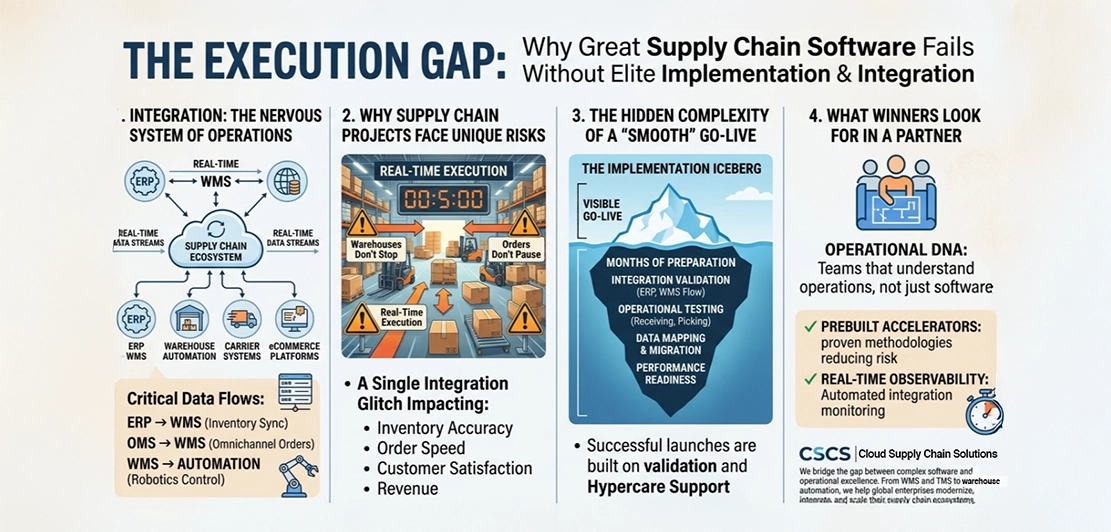
In today’s supply chain world, integration is no longer a supporting function; it is the nervous system of operations. Companies are investing millions in modern platforms such as Warehouse Management Systems (WMS), Transportation Management Systems (TMS), Order Management Systems (OMS), ERP platforms, automation systems, visibility solutions, and AI-driven analytics.
But the reality remains consistent: without strong integration and disciplined implementation, even the most advanced technologies fail to deliver consistent business outcomes.
1. Integration: The Nervous System Of Operations
Integration is what connects the entire supply chain ecosystem together. It enables:
Real-time inventory visibility across systems
Seamless order orchestration from channel to warehouse
Automated execution between WMS, OMS, ERP, and TMS
Carrier connectivity and shipment tracking
Data consistency across all operational systems
Without integration, systems become isolated islands of data. This leads to:
Manual workarounds
Delayed order processing
Inventory mismatches
Limited operational visibility
2. Why Supply Chain Projects Face Unique Risks
Unlike traditional IT implementations, supply chain projects operate in real-time environments where operations cannot pause. Warehouses continue to process orders. Customers expect same-day or next-day delivery. Carriers operate on strict schedules.
This creates unique risks such as:
High-volume transaction dependencies
Multiple system integrations running simultaneously
Automation and robotics dependencies
Peak season pressure during go-live
Cross-functional operational impact
A single integration failure can affect:
- Order fulfillment speed
Inventory accuracy
Shipping performance
Revenue recognition
This is why supply chain implementations require deep operational understanding not just technical expertise.
3. The Hidden Complexity Of A Smooth Go-Live
A successful go-live often looks simple from the outside, but it is built on months of structured execution behind the scenes. Key components include:
Integration Validation
Ensuring end-to-end data flow across ERP, WMS, OMS, TMS, and automation systems.
Operational Testing
Validating real-world scenarios such as receiving, picking, packing, shipping, returns, and exception handling.
Performance Readiness
Ensuring systems can handle peak volumes and operational spikes without degradation.
Cutover Planning
Executing controlled transitions from legacy systems without disrupting business operations.
Hypercare Support
Providing rapid issue resolution and stabilization support immediately after go-live. Each layer adds resilience to the implementation.
4. What Winners Look For In A Partner
Leading organizations no longer view implementation partners as staffing providers. They look for strategic execution partners who can deliver outcomes. Key expectations include:
Deep Operational Understanding
Partners must understand warehouse, transportation, and fulfillment operations, not just software systems.
Integration Expertise
Strong capability across API design, real-time event processing, and multi-system orchestration.
Accelerators And Reusable Assets
Prebuilt integration frameworks and proven implementation methodologies that reduce time-to-value.
Risk Reduction Focus
Strong governance, testing discipline, and cutover planning to ensure go-live success.
Scalability
Ability to support multi-site, multi-region global deployments.
Continuous Value Creation
Support beyond go-live into optimization, automation, and transformation.
The Path Forward
Supply chain transformation success is no longer defined by software selection. It is defined by how well systems are integrated and how effectively they are implemented. The organizations that succeed consistently are those that treat integration as the foundation and implementation as the execution engine.
At CSCS, we believe the future belongs to connected, intelligent, and operationally resilient supply chains powered by strong integration and implementation discipline.
About CSCS
CSCS helps organizations modernize and optimize supply chain operations through Deep. expertises, systems integration, automation connectivity, and scalable technology delivery across WMS, TMS, OMS, ERP, and warehouse automation ecosystems.

Blog by:
Maharajan Karthigaivelayutham (Maha)
Chief Delivery Officer, CSCS